
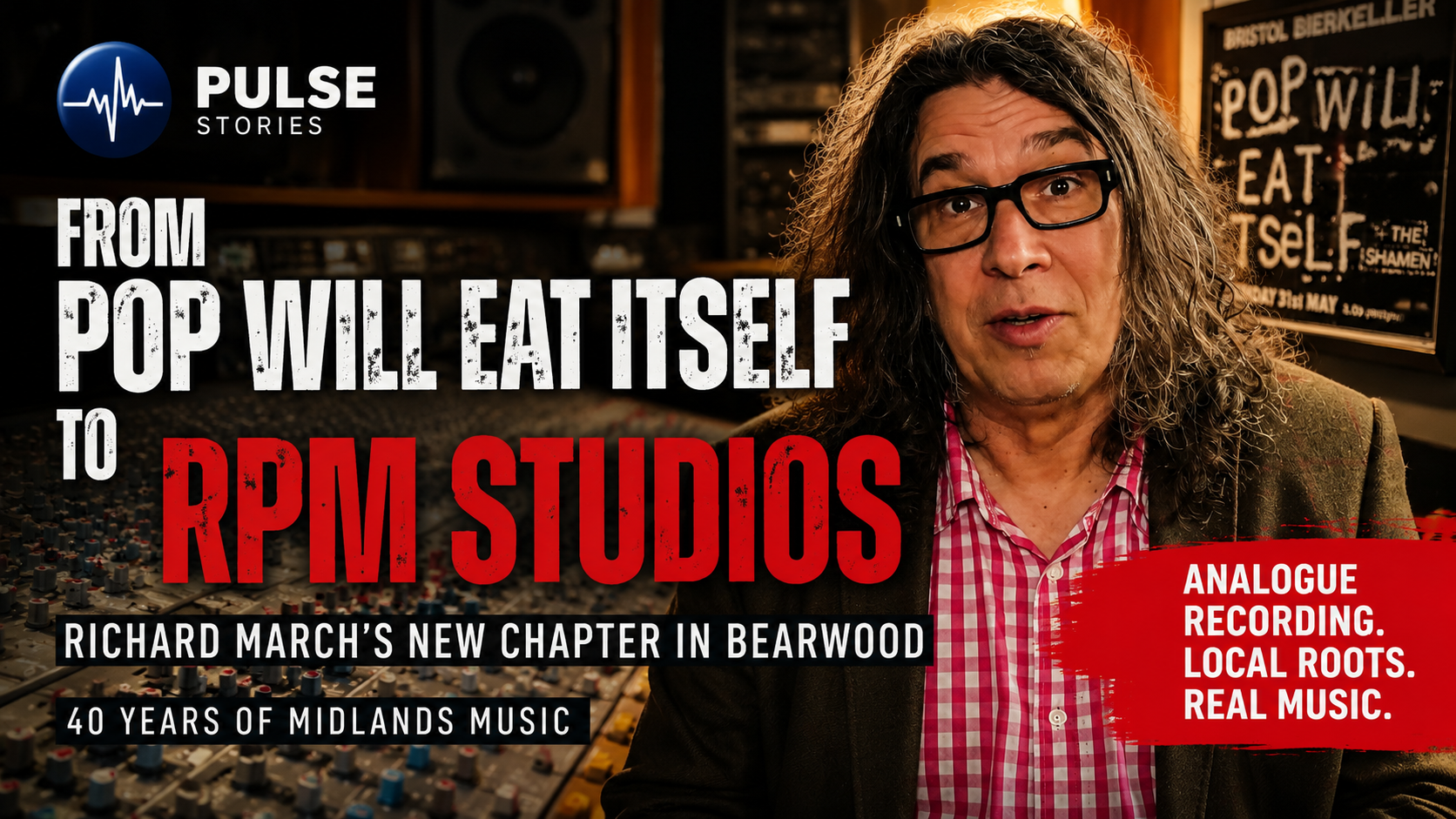
Richard March, founder member of Pop Will Eat Itself and Bentley Rhythm Ace, is opening RPM Studios in Bearwood, 40 years after his early DIY days in Midlands music.
A Midlands music career that began with self-financed records has come full circle in Bearwood.
Richard March, founder member of Pop Will Eat Itself and later Bentley Rhythm Ace, is opening RPM Studios – a new analogue recording space inside RPM Audio.
The launch marks 40 years since Pop Will Eat Itself’s early days, when the Stourbridge band began with self-financed records, handmade sleeves and the kind of DIY approach that shaped much of the alternative Midlands music scene.
But March is not treating the new studio as a nostalgia project.
Before the interview, when asked what title he wanted on screen, he pushed back against being defined only by something he did 40 years ago.
He settled on the simple version: owner of RPM Audio.
For March, the studio is another stage in a long working life in music.
“I think this is another stage in my journey,” he said.
“I started off my career as a performing musician and as a composer, as a performer, as a recording artist.
“I was very blessed to spend a good 10 or 15 years travelling around the world, playing gigs in America and Australia and Japan and all over Europe, releasing records and playing big shows.”
After that, March moved into music education, working with young people starting careers in music and production.
RPM began from a different but connected passion: vintage audio equipment.
March said he opened the original RPM Audio shop because he felt there was not anywhere in the Midlands properly catering for people interested in that world.
The business has since grown beyond its first premises.
RPM Audio now operates from a larger building on Bearwood Road, bringing together vintage hi-fi, records, repairs, a performance space, a gallery, a bakery and the new recording studio.
March said the bigger building gave him the chance to shape something more connected.
“I really wanted to have a space where people could come and sit and relax and listen to music and have a great cup of coffee,” he said.
From there, the idea grew into live performances, events, art exhibitions and a studio upstairs.
One of the clearest ideas behind RPM is that each part of the building can feed into the next.
An artist could perform in the downstairs space, record through the studio upstairs, sell music through the record shop, and have people listen to it over coffee on vintage audio equipment.
March described it as a “holistic experience”.
That independent approach still runs through the project.
“The idea about doing it yourself is you can do it exactly how you want to do it,” he said.
“I can choose the exact people that I want to work with. I can decide what colour I want to paint the walls. I can decide what artwork I want on display.”
He said independent spaces can reflect a person’s personality in a way a corporate business often cannot.
That flexibility also allows RPM to respond to what customers and artists actually want, rather than simply stocking or programming the same thing regardless of the people using the space.
Bearwood is central to that.
March said the area has many independent retailers and fewer large corporate stores than some other nearby places.
He also said cost and location matter, with Bearwood easier to reach from outside Birmingham than the city centre for some visitors.
The studio itself is being described as an analogue recording space with digital options.
March said the value of analogue is not just about claiming one format is better than another.
He sees it as an experience.
“If you’ve got an LP record and you put the needle on the record, there’s a connection to that music that you don’t get from pressing a button on your phone,” he said.
“For me, it’s the wonder and the magic of a tiny little needle moving backwards and forwards creating this sound coming out of the speakers.”
He added: “Different and better aren’t the same thing, but sometimes different can be better.”
For young artists, producers and engineers, March believes RPM Studios can offer access to equipment and experience they may not easily get elsewhere.
“At the end of the day, I want people to be able to make better sounding records than they would otherwise be able to,” he said.
“I want people to have the experience of mixing on an analogue console rather than in the box on their laptop.
“I want people to have the experience of using real equipment rather than virtual equipment.”
He said even students studying music technology at degree level may rarely get the chance to work with the kind of analogue equipment now housed at RPM.
That could matter for careers as well as creativity.
March said experience with both analogue and digital equipment can help people looking to work as engineers or producers, while artists can gain an edge if their music sounds different from everything else around them.
The project also sits within a wider conversation about the West Midlands music scene, high streets and independent cultural spaces.
Lyle Bignon, who works across music, media and the night-time economy, said music has always played an important role in connecting high streets and communities.
He said RPM’s growth adds to the rejuvenation of the high street and gives music lovers, producers and artists another place to gather, create and develop their work.
But he also pointed to the pressure on small businesses.
He said independent venues and creative spaces need support from regional authorities, local councils, central government, consumers, communities, music makers and music lovers.
That is where the story becomes more than one studio opening.
The West Midlands has a strong music identity, but the smaller spaces that support artists, audiences and local scenes often work with tight margins and practical pressures.
RPM Studios adds a new room to that landscape.
For March, success will not simply mean opening the doors.
He said he would like the studio to be so busy that he and engineer Alastair Jamieson struggle to get in there to work on their own projects.
He also wants RPM to become a destination beyond the studio itself.
A place for records. A place for coffee. A place to hang out. A community hub.
“It’s such a great space,” he said.
“There’s so much potential to do so many different things here that it would be a real shame if people didn’t take the opportunity to use it.”
RPM Studios connects several parts of one local story.
A Midlands music career. A Bearwood high street. A new room for recording. And a wider region still working out how to protect the small spaces where culture begins.
The value will not only be in the opening.
It will be in what gets made next.